
Pirate Galleon
A galleon was a large, multi-decked sailing ship used primarily by the nations of Europe from the 16th to 18th centuries. Whether used for war or commerce, they were generally armed with cannons. Pirate Ship book (Amazon affiliate link)
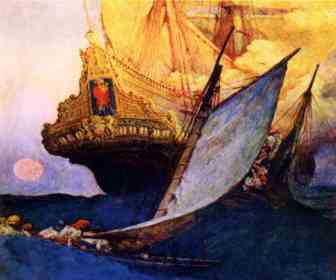
Pirate galleons were an evolution of the caravel and carrack for the new great ocean-going voyages. A lowering of the forecastle and elongation of the hull gave an unprecedented level of stability in the water, and reduced wind resistance at the front, leading to a faster, more maneuverable vessel. The pirate galleon differed from the older types primarily by being longer, lower and narrower, with a square tuck stern instead of a round tuck, and by having a snout or head projecting forward from the bows below the level of the forecastle.
In Portugal at least, carracks were usually very large ships (often over 1,000 tons), while galleons were mostly under 500 tons, although the Manila galleons could reach up to 2,000 tons. Carracks tended to be lightly armed and used for transporting booty from the Far East, while galleons were purpose-built warships — stronger, more heavily armed, and also cheaper to build, making them a much better investment for use as warships.
The pirate galleon was powered entirely by sail, carried on three to five masts, with a lateen sail continuing to be used on the last mast. They were used in both military and trade applications, most famously in the Spanish treasure fleet and the Manila Galleons. The galleon was the prototype of all three-or-more-masted, square-rigged ships for over two and a half centuries.
The Pirate Galleon in Battle
These famous trade and treasure ships designed by the Spanish shunned the low-armament idea of other merchant vessels and were truly a force to be reckoned with. With a crew upwards of 200 manning two or three decks of over 70 cannon, numerous swing guns, and even archers’ platforms on the three or four masts, this virtual man-of-war would use resistance only as a last but fearsome resort — broadsides were deadly. Still, the pirates came after it, because the top speed of around eight knots could not begin to compensate for quirky design features which made it difficult to maneuver in less than ideal seas. Massive square sails that prevented sailing into the wind, a hull broad at bottom and narrow at top, and a tiny keel all conspired to make it behave more like a washtub than a warship — and someone was always waiting to drain it dry.
Before the galleon, the Spanish and Portuguese sailed huge carracks on their trade routes. These well-armed three-masted ships were the biggest around and could reach over 1,100 tons. A carrack could most always fend for itself against pirates.
See also our page about all pirate ships.
As both an Amazon and eBay Associate I earn from qualifying purchases.
All content ©2003– The Pirate's Realm unless otherwise noted. All rights reserved. Privacy Policy